



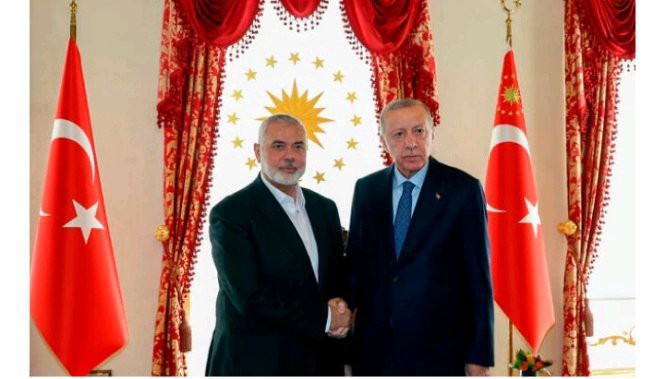
US frowns at relocation of Hamas leaders from Qatar to Turkey
According to a report from The Times Of Israel. The United States has issued a stern warning to Turkey over reports that several senior Hamas leaders have recently relocated to Istanbul after leaving Qatar.
The move, which has raised concerns in Washington, is seen as part of an ongoing shift in Hamas’ operations and leadership dynamics within the region.
The U.S. has urged Turkey to reconsider any potential support or sheltering of Hamas officials, signaling a growing tension between the two NATO allies on matters related to terrorism and Middle East security.
The warning comes amid reports that a number of senior figures from Hamas, the Palestinian militant group designated as a terrorist organization by the U.S., European Union, and Israel, have quietly left their headquarters in Doha, Qatar, and moved to Turkey.
While Turkey has long been a supporter of the Palestinian cause, its increasing ties to Hamas have sparked alarm in the West, particularly as Hamas remains engaged in violent conflicts with Israel and other regional powers.
The potential relocation of key Hamas leaders to Turkey is seen as a potential escalation in the already complex dynamics surrounding the Israeli-Palestinian conflict.
Hamas, which has controlled the Gaza Strip since 2007, has faced increasing diplomatic isolation over the years. Qatar has long provided political and financial support to Hamas, offering the group a safe haven and diplomatic space to operate, despite international calls to sever ties with the militant organization.
However, recent reports suggest that some of the group’s top officials have left Doha in response to growing pressure from both regional and international actors.
The relocation of Hamas leaders to Turkey is seen by analysts as part of a broader reshuffling of the group’s leadership, which may be driven by various geopolitical considerations, including Qatar’s own shifting foreign policy priorities.
While Qatar has maintained its relationship with Hamas, the emirate’s recent efforts to improve ties with Israel and the United States have led some Hamas figures to seek alternatives, with Turkey emerging as a potential new base of operations.
Turkey, under President Recep Tayyip Erdoğan, has been an outspoken critic of Israel and a staunch supporter of the Palestinian cause.
The Turkish government has also had a longstanding relationship with Hamas, providing both political and financial backing, despite the fact that Hamas is classified as a terrorist organization by Israel, the U.S., and the European Union. In recent years, Turkey’s ties with Hamas have raised concerns in Washington, particularly as the U.S. intensifies efforts to counteract what it views as Iran’s influence in the region and combat the activities of groups it deems terrorist organizations.
The United States has made it clear that it views any move by Turkey to harbor Hamas leaders as a serious issue, particularly as it seeks to maintain pressure on Hamas and curb its ability to operate freely across the Middle East.
Washington’s primary concern is that providing refuge to Hamas officials could undermine efforts to achieve a peace agreement between Israel and the Palestinians, while also emboldening a group that continues to engage in acts of terrorism, including rocket attacks and suicide bombings aimed at Israeli civilians.
A senior U.S. official, speaking on the condition of anonymity, emphasized that Turkey’s harboring of Hamas leaders would be “a direct contradiction” to its commitments to counterterrorism and its responsibilities within NATO.
The official further stated that such a move would not only damage Turkey’s relations with the U.S. but could also jeopardize the country’s standing within the international community.
The U.S. has repeatedly urged Turkey to take stronger action against Hamas and other militant groups operating in the region, calling on Ankara to close down Hamas offices within its borders and distance itself from organizations that promote violence.
While Turkey has insisted that its support for Hamas is based on a broader commitment to Palestinian rights and self-determination, the U.S. and other Western nations view Hamas’ tactics, including targeting civilians and its stated goal of destroying Israel, as incompatible with global counterterrorism efforts.
In response to the U.S. warning, Turkish officials have maintained a defiant stance, rejecting any suggestion that Hamas should be treated as a terrorist group.
Turkey’s Foreign Minister Mevlüt Çavuşoğlu reiterated that Turkey’s position on Hamas is aligned with its broader stance on Palestinian rights, noting that Ankara does not view the group in the same light as Western powers do.
Çavuşoğlu emphasized that Turkey’s relationship with Hamas is part of its broader foreign policy objective of supporting the Palestinian cause and fostering a more balanced approach to Middle East diplomacy.
“Turkey has consistently supported the Palestinian people and their legitimate struggle for self-determination,” Çavuşoğlu said in a recent statement. “We do not consider Hamas a terrorist organization, but rather a resistance movement that represents the Palestinian people.”
The Turkish government has also suggested that its relationship with Hamas is not a sign of support for terrorism, but rather an attempt to mediate in the Israeli-Palestinian conflict and promote a peaceful resolution.
Turkey has long advocated for a two-state solution, though its support for Hamas has made it an outlier among Western countries, which generally back the Palestinian Authority and its efforts toward peace negotiations with Israel.
The potential relocation of Hamas leaders to Turkey further complicates Ankara’s already delicate relationship with its NATO allies.
While Turkey remains an integral part of the alliance, its increasingly independent foreign policy, particularly in the Middle East, has caused friction with the U.S. and European countries.
Turkey’s support for Hamas and its military actions in Syria and Libya have already strained ties with the West, and the recent developments in Gaza and Lebanon have exacerbated concerns over the country’s geopolitical alignments.
The situation is particularly sensitive as the U.S. is working to counter Iranian influence in the region, which includes supporting groups like Hamas and Hezbollah.
Turkey’s relationships with these groups, coupled with its own growing ties with Iran, have raised concerns in Washington about the direction of Turkey’s foreign policy.
As the U.S. seeks to isolate Iran and its proxies, including Hamas, Turkey’s decision to host senior Hamas figures could complicate efforts to stabilize the Middle East and limit Iran’s regional influence.
In the broader context, Turkey’s support for Hamas also has implications for the Israeli-Palestinian conflict.
While Turkey’s position on Palestinian statehood has garnered some sympathy in the Arab world, its relationship with Hamas could undermine efforts to bring about a peaceful resolution.
Hamas remains a major obstacle to peace talks with Israel, and many Palestinian and Arab leaders view the group’s rejection of any compromise with Israel as a significant challenge to achieving a two-state solution.
Despite the tensions between the U.S. and Turkey over Hamas, there remains potential for diplomatic engagement.
Some analysts suggest that the U.S. could seek to address its concerns with Turkey through behind-the-scenes negotiations, rather than through public confrontations. Washington’s primary goal will likely be to ensure that Turkey does not provide shelter to Hamas leaders, but also to prevent further deterioration of the broader U.S.-Turkey relationship, which has been a cornerstone of NATO unity for decades.
Ultimately, the issue of Hamas and its presence in Turkey will remain a point of contention in U.S.-Turkey relations.
As Turkey continues to assert its influence in the Middle East, balancing its support for Palestinian groups with its relationships with the West will be an ongoing challenge.
The future of Hamas in Turkey, and the implications for regional stability, will be closely watched by both Western powers and regional actors alike.
Source: Opera News


